You ran a bank branch in Lagos, kept a university’s systems alive in Nairobi, managed a hospital floor in Addis — and here, that history gets a polite nod and no callbacks. The US market can’t read your résumé yet. Cloud is one of the few careers here where proof beats pedigree: real deployments you can show an interviewer, built on material you can verify for free before you pay anyone a dollar.
Everything on this page except the live cohort is free. That is deliberate — read on.
You have seen the ads promising a cloud job in 90 days. Here is the version you can repeat to your family without flinching.
What it really costs. Time, mostly. If you are studying 8–10 hours a week around shifts — after work, on the train, Saturday mornings — plan on 12 to 18 months from Class 1 to a credible first application. Anyone quoting 3 months is assuming you quit your job, and you are not going to quit your job. The money side starts at $0: the classes, labs, exam practice, and résumé templates below are free and public.
What it pays. US cloud engineer pay commonly lands somewhere between roughly $95,000 and $140,000 depending on city, employer, and level — that range is consistent across BLS wage data and Levels.fyi as of 2026. The exact numbers move every year; the direction does not. Even the low end changes the arithmetic on rent, the car note, and what goes home each month.
The anti-scam promise. Your community’s WhatsApp groups carry two kinds of stories: who got the cloud job, and who got scammed. The $500 course with a “guaranteed job.” The outfit that puts fake experience on your résumé for a fee — which can end a career the day a background check runs. Our answer is structural: everything we teach is verifiable free before you pay anyone. Read the classes, run the labs, check the instructors’ backgrounds. If the free material is not good, keep your money. That is the whole point of this page.
Every article below was written for one reader: the person who was a professional back home and is rebuilding here around a survival job. Start with the map, then read the cluster that matches where you are.
What cloud work actually is, why your professional history transfers better than you think, and the honest route in from where you stand today. Every other article branches off this one.
Reading tells you whether the path is real. Building tells you whether you want it. All four of these are free, public, and open right now — no card, no account wall in front of the learning.
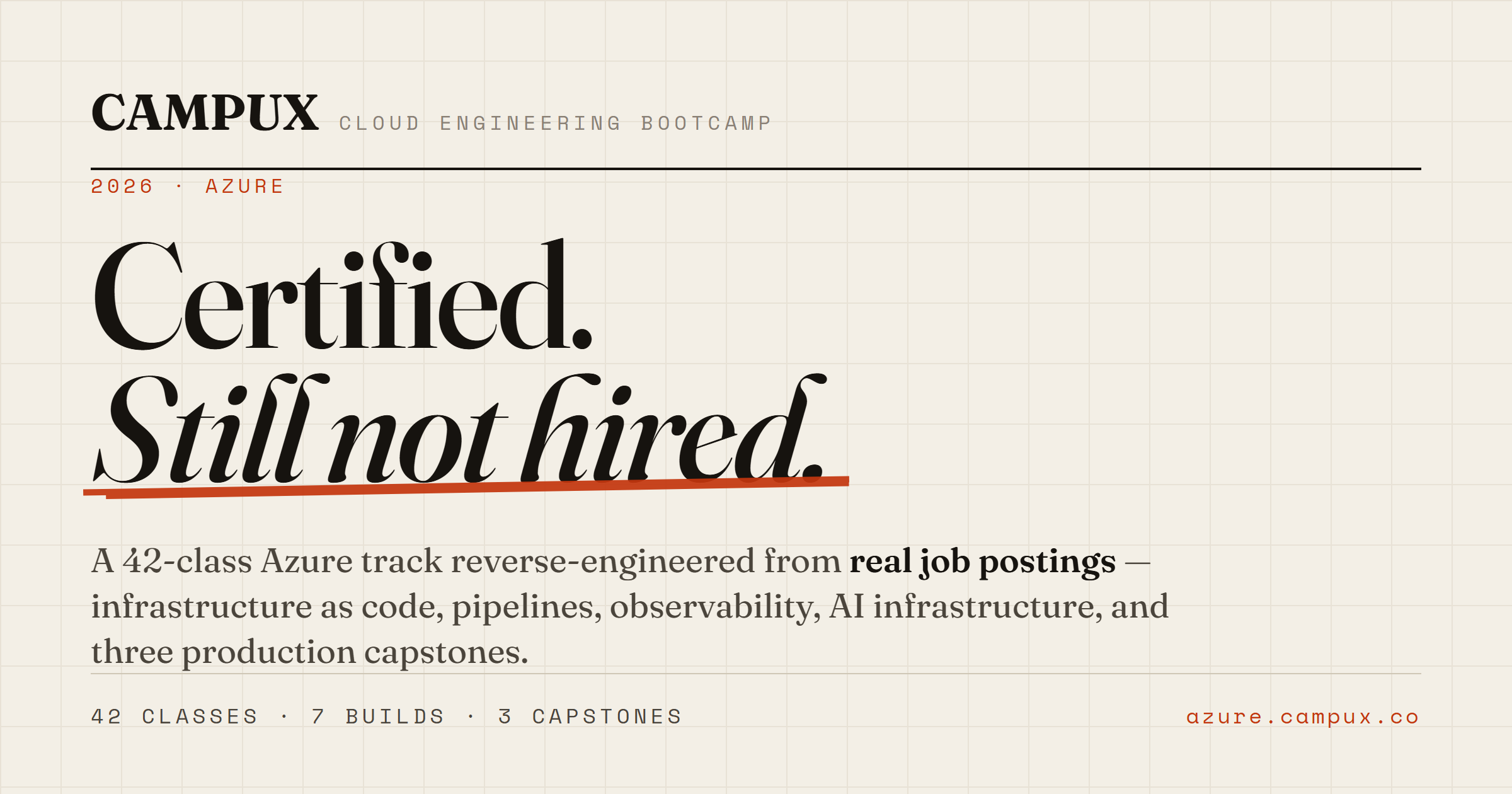
The full self-paced bootcamp, Class 1 through 42 — the same fundamentals-to-engineering arc the paid cohort walks, readable tonight after a shift. Start with Class 1: What is cloud?
Real Azure labs in a public GitHub repo — CLI and infrastructure-as-code, inspectable before you run a single command. github.com/kloudcaptain/campux-labs
Hundreds of practice questions across the Azure certification exams, free and open — measure yourself before you spend a dollar on a voucher. Try the exam practice
US-format cloud résumé templates you can download as PDF or Word — the one-page norm, already laid out the way recruiters here expect. Get the templates
If the free material is weak, you lose nothing but an evening. If it is good, you have your answer about us.
Captain O is self-taught. He was a helicopter pilot before he taught himself cloud — no computer science degree, no tech pedigree, just the same kind of career switch you are weighing now. Today he works as a Senior Cloud Engineer and Cloud InfoSec Program Manager, with nine years in IT, six of them on Azure, and 14+ certifications.
He teaches alongside a Senior AWS and Azure Engineer with over 20 years in IT. Two instructors, two clouds — so when you hit a wall at 11pm, someone in the room has already been through it.
That is the whole biography. No stock-photo “team of industry experts,” no invented alumni. Named people with verifiable backgrounds — the same standard you should hold every program to.
Self-study fails people with 12-hour shifts for a boring reason: the schedule has no outside force. A live cohort supplies one — fixed sessions you show up to, instructors who unblock you the same night, and a room that notices when you disappear for a week. For someone whose discipline is already proven and whose hours are already spoken for, external structure is the highest-probability path.
$1,800 is a serious family decision. Take it after the free material has earned your trust, not before.
One thing said plainly: we do not sponsor visas and we do not promise jobs. We teach you to build, and help you prove it.
No. Most cloud postings ask for a degree or equivalent experience, and hiring managers read equivalent generously when you can show real deployments. A foreign degree can be evaluated through a service like WES if a specific employer asks. What moves your application is proof you can build — and that proof is free to earn.
Your English is not the problem — interview format is. Phone screens reward short, structured answers, and that is a practicable skill, not a personality trait. Rehearse walking through one project you built until you can do it in two minutes. Interviewers hire the person whose explanation they can follow, and clarity is something you can train.
Yes — that is who this was built for. The honest math: 8 to 10 hours a week of fragmented study, after shifts and on Saturday mornings, puts the timeline at roughly 12 to 18 months, not 3. The free classes are self-paced for exactly that reason, and the live cohort runs on a fixed schedule so the structure comes from outside your willpower.
Check for yourself before you pay anyone. All 42 classes are free and public, the labs live in a public GitHub repo, the exam practice is free, and the instructors are named with specific, verifiable backgrounds. A program that hides its material until you pay is asking for trust. We are asking for inspection.
No. CAMPUX does not sponsor visas, and nothing on this site is immigration legal advice. We can explain generic hiring mechanics — for example, what the sponsorship question on a job application means, and that a green card holder answers no to it. For anything about your own status, talk to your attorney or your DSO.
It takes twenty minutes and costs nothing. If it reads like someone finally explaining this properly, keep going — the map above will carry you the rest of the way. And send this page to the one person in your WhatsApp group who has been asking about cloud. That is how the real ones travel.